Why Bakers Should Use a Scale
If you're running a micro, home bakery or cottage business, your products are more than just treats. They're your reputation. Every cookie, loaf, or pastry you sell reflects your brand, and consistency is everything. That's why I want to talk about why bakers should use a scale, which is one of the most overlooked (but most important) tools in any kitchen.
While many home bakers start out with cups and tablespoons, anyone who's serious about selling baked goods needs to move beyond them. Here's why: cup measurements aren't accurate, reproducible, or scalable. And those three qualities are exactly what you need to grow a reliable home or micro bakery.
Here at Kitchenlicious I do my best at providing both home and gram measurements for every single recipe, always with the disclaimer that I have personally only tested the recipe using the gram measurements and you should do the same yourself. More often than not, issues with recipes (mine or otherwise) stem from not following the recipes in grams, leading to unwanted results such as cookies spreading or unexpected textures.
Why Cups and Spoons Don’t Work for Professional Baking
Baking is a science. Every ingredient interacts in a precise way, and a little too much (or too little) can throw off the entire recipe. Unfortunately, cups and tablespoons are imprecise by nature.
1. Inconsistency in Measurement
- A cup of flour can weigh anywhere from 110g to 150g depending on how it's scooped, packed, or fluffed.
- A tablespoon of butter might vary by several grams depending on how it's cut.
- Even small inconsistencies multiply when you're baking at scale (even by simply making a double or triple batch of a recipe).
For a home baker making a single batch, this might just mean slightly different cookies every time, which is fine if you're just making a treat for friends and family. But for a business, inconsistency is a risk to your product quality and customer trust.
2. Reproducibility Issues
Let's say you develop a cookie recipe you love. You write it down as "2 ½ cups flour." If you give that recipe to someone else (or try to recreate it yourself months later), chances are the results will be different. Why? Because "2 ½ cups flour" isn't a standard weight.
On the other hand, if your recipe calls for 315g flour, it will always mean the same thing, whether you bake it tomorrow, next year, or hand it off to an employee.
3. Scaling Problems
Running a bakery means scaling recipes up and down depending on orders. Cups make this nearly impossible. Try multiplying the same "2 ½ cups flour" by 12 and you'll quickly see the problem.
But with a scale, scaling is simple:
- 315g flour × 12 = 3,780g flour.
No messy conversions, no inconsistencies. Just accuracy.
Why a Scale is Non-Negotiable for a Bakery
When you're selling baked goods, customers expect consistency. They want the same cookie they loved last week, not one that's smaller, denser, or drier this time around. A scale ensures:
- Accuracy: Every batch uses the exact same amount of each ingredient.
- Consistency: Your products come out the same every time, which builds trust.
- Efficiency: Weighing is faster than scooping cups and tablespoons.
- Professionalism: If you want your business to grow, your recipes need to be reliable and scalable.
Practical Example: Cookies with and without a Scale
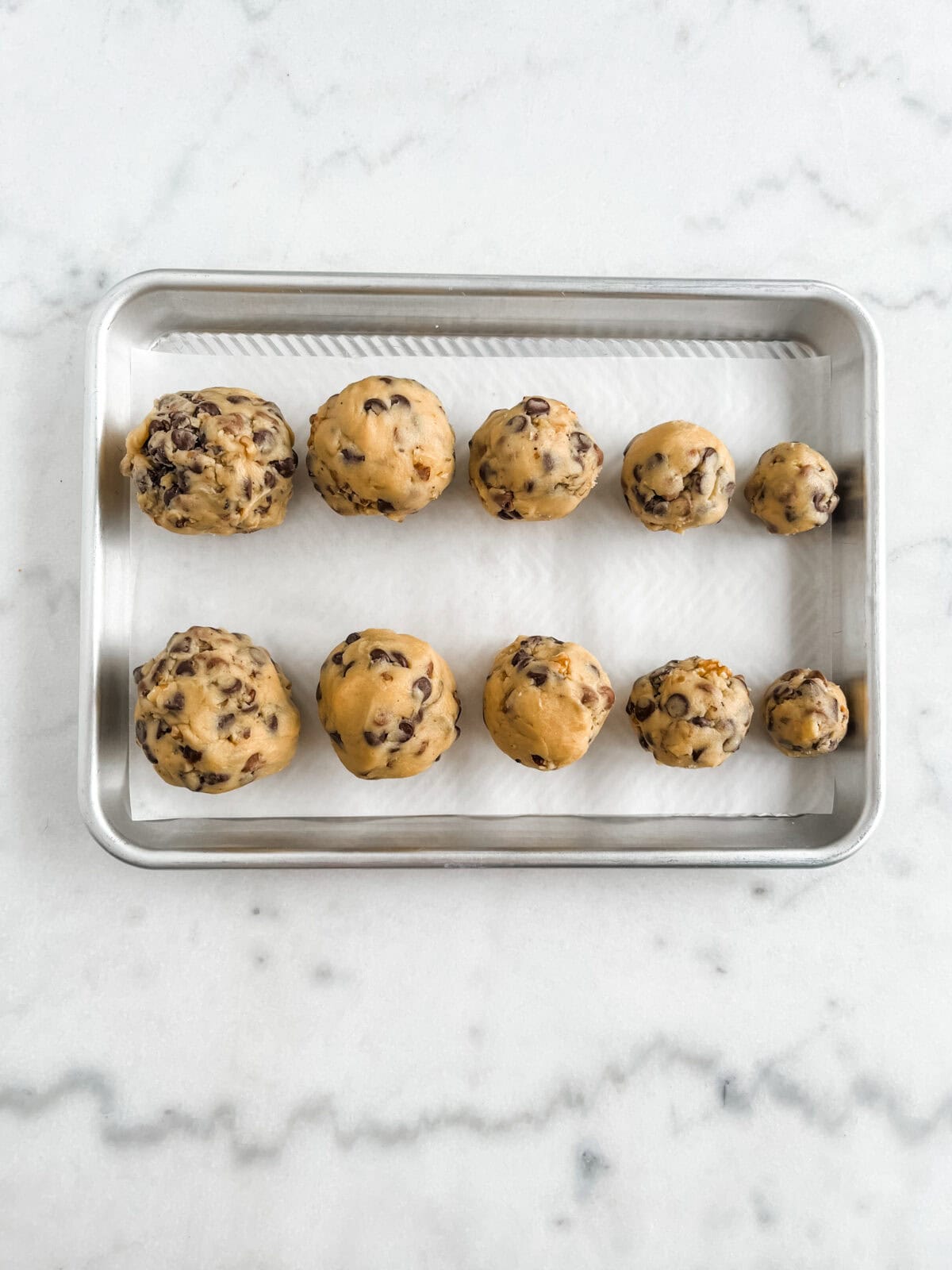
Let's look at chocolate chip cookies as an example.
- Cup Method:
- 2 ½ cups flour → anywhere from 275g to 375g depending on the baker. That's a 100g difference.
- Result: one baker gets dry, cakey cookies while another gets flat, greasy ones.
- Scale Method:
- 315g flour → always exactly 315g.
- Result: cookies bake consistently every time, no matter who makes them.
Now imagine trying to sell cookies as a product. Which version would you want customers to associate with your brand?
Transitioning from Cups to a Scale
Switching from cups to grams might feel intimidating at first, but once you try it, you'll never look back. Here's how to make the shift:
- Invest in a Good Digital Scale
Look for one with gram accuracy (down to at least 1g) and a tare function. I personally own one that can weigh up to 10kg (or 10000g) with a gram accuracy and another one that can weigh up to 3kg (or 3000g) with a 0.1g accuracy. For most cottage bakers this is more than enough. - Convert Your Recipes
Start by converting your most popular recipes into grams. Use reliable conversion charts or weigh ingredients as you measure them by cups the first few times. - Document Everything by Weight
From now on, write recipes by grams, not cups. This makes them reproducible and professional. - Train Anyone Helping You
If you ever expand your bakery, having recipes in grams makes training employees foolproof.
The Business Case for Using a Scale
At the end of the day, a scale isn't just about baking, it's about running a business. When you bake for yourself, friends or family "close enough" measurements might be fine. But when you bake for others, every detail matters.
- A scale reduces waste.
- It saves you time when baking (and time = money).
- It ensures every customer gets the same experience, every time.
And most importantly: it sets you apart as a professional.
Final Thoughts
If you want to run a successful home or micro bakery, you need to treat your recipes like assets. They should be accurate, reproducible, and scalable. Cups and spoons can't deliver that. A scale can.
So if you're serious about your baking business, invest in a scale today. It's the cheapest and single simplest upgrade you can make, and it will pay off with every batch you bake.